
AI Hospitality Insights
Google Gemini 3.5: From the Cached Web to Machine-Readable Hotel Infrastructure
Published: May 29, 2026
Last Updated: June 14, 2026
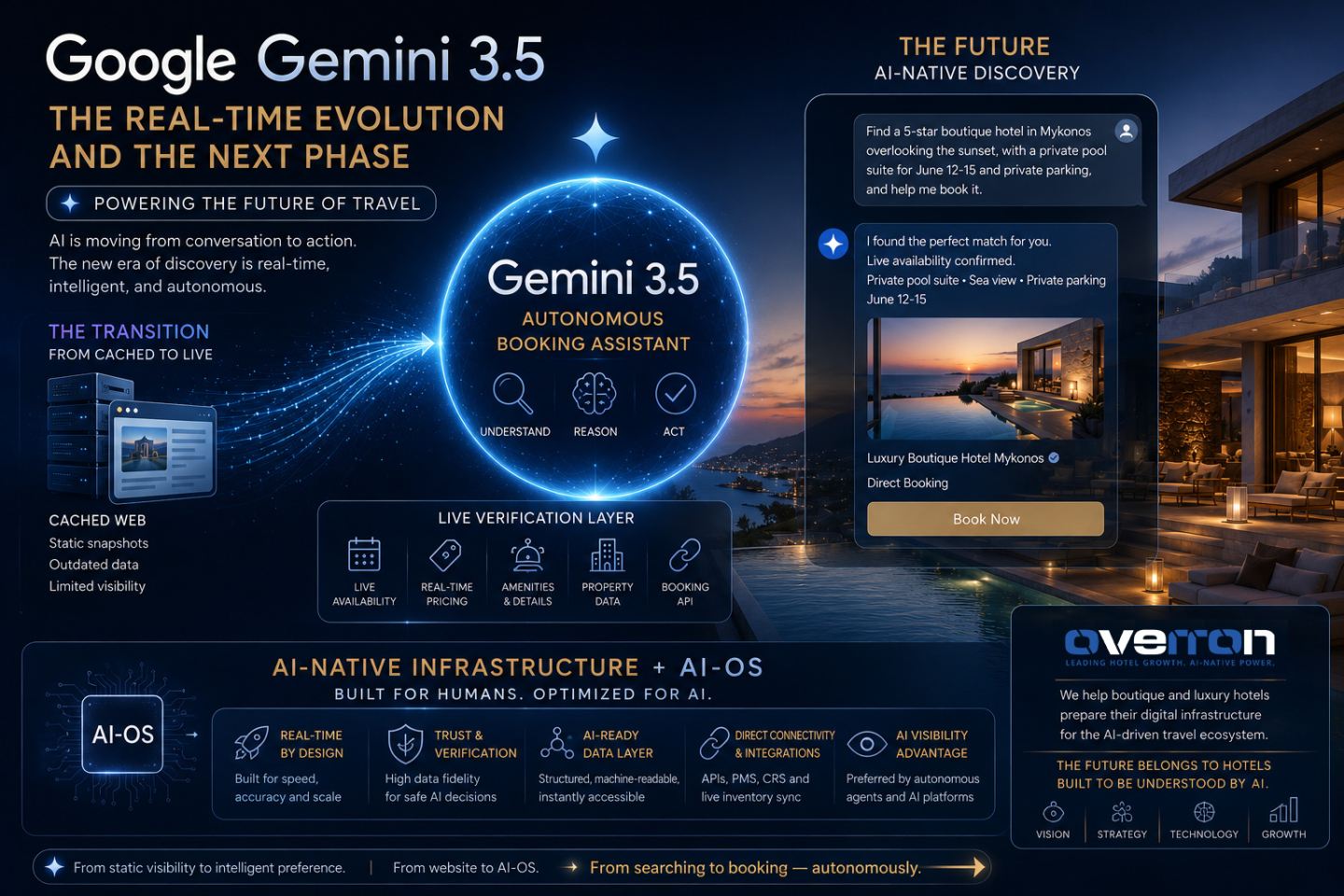
The way hotels get bookings online is entering a transitional shift. With the gradual rollout of Google’s Gemini 3.5 and the evolution of smart mobile ecosystems, artificial intelligence is steadily moving from a conversational assistant you chat with toward an autonomous booking assistant driven by frameworks like Overron AI-OS.
For decades, hotel SEO worked as a digital archive. Search engines would visit a hotel website, take a static "snapshot" of the text, and save it to show it to users later. This cached web model isn't disappearing overnight, but it is no longer enough on its own. We are moving into a hybrid era where saved snapshots are being heavily augmented by instant, real-time data verification.
When a next-generation AI agent processes a live request for a traveler, it cannot rely solely on days-old cached information to make highly accurate recommendations. It prioritizes systems that can instantly verify availability and precise details at that specific moment. To secure a competitive advantage in this evolving landscape, progressive hotels are beginning to upgrade their traditional sites into AI-Native Infrastructures — systems built to stream live, accurate data directly to AI-driven ecosystems.
Decoding Gemini 3.5: Preparing for Real-Time Action
Until recently, AI chatbots primarily scanned saved internet indexes to list general text options for a traveler, acting much like a digital brochure.
The architecture behind Google Gemini 3.5 and upcoming agentic models points to a different future. These systems are being engineered to not just read information, but to reason and coordinate with live networks. They introduce workflows designed to check live room availability, cross-reference real-time pricing, and streamline the booking path—reducing the steps a human user has to take across multiple websites.
As tech ecosystems like Siri and Galaxy AI integrate deeper with these models, we can see where the industry is heading. A traveler might soon prompt their device with a multi-variable request:
"Find a 5-star boutique hotel in Mykonos overlooking the sunset, check if they have an available private pool suite for June 12-15, ensure the property has a private parking area, and help me start the booking process."
While fully automated, end-to-end AI execution will scale up gradually over the coming months as new versions roll out, the priority alignment is already happening. Instead of just returning a long list of random links, the AI aims to filter out high-latency sites and prioritize properties whose data can be instantly verified.
The Big Challenge: Preparing Infrastructure for the Hybrid Era
The immediate bottleneck for these evolving AI agents is the structural limitation of legacy hotel websites. Traditional websites and standard SEO plugins were built exclusively for the cached search era. They often bury operational data behind complex visual layouts and scripts that AI crawlers cannot parse efficiently in real time.
As AI models become more action-oriented, they require high data fidelity to operate safely without making booking mistakes. Properties that continue to rely solely on old, static content layers risk becoming invisible to these new channels. Securing priority in AI recommendations requires exposing data through clean, machine-readable digital structures.
| Legacy Websites (Static Model) | AI-Native Evolution (Hybrid Priority) |
|---|---|
| Reliance purely on static SEO plugins & cached snapshots | Hybrid integration of Real-Time Data Layers |
| Heavy, complex code optimized only for human browsing | Optimized, low-token data structure for fast AI verification |
| Isolated booking layers causing data delays | Direct, machine-accessible channels (AI-Ready Infrastructure) |
The Timing Paradox: When Will AI Bookings Go Live?
While tech giants are rapidly rolling out agentic features across retail and restaurants, full machine-to-machine hotel bookings are projected to scale globally between late 2026 and early 2027. However, waiting for the technology to fully mature before upgrading your infrastructure is a critical digital blindspot.
To understand how AI search engines index and build algorithmic trust over time, read our deep-dive analysis on The First Mover Advantage in AI Hospitality: Time is the Real Currency for Hotels & Resorts.
Architecting for the Transition
Transitioning to an AI-ready ecosystem is a strategic timeline, not an overnight switch. To secure direct booking volume as Gemini 3.5, autonomous assistants, and mobile AI networks mature, luxury hotel brands must begin upgrading their digital foundation today.
By establishing a real-time data layer alongside their existing human-centric websites, hotels position themselves to be trusted by autonomous agents as these features deploy globally. When an AI agent can reliably verify a property’s infrastructure data, it establishes that property as a preferred choice for direct execution, protecting the hotel's bottom line from heavy reliance on third-party intermediaries.Engineering a machine-accessible, real-time backend is no longer about chasing a futuristic trend—it is about laying the groundwork now to ensure visibility tomorrow. To explore how boutique and premium hotels are currently adapting their digital framework for the next generation of live LLMs, analyze our deep-dive technical overview on generative search visibility and advanced AI-OS.
Are you ready for the Agentic Era?
See the global standard in action. Explore our curated global directory of AI-Native Verified Hotels that have already upgraded their infrastructure to support autonomous AI bookings.
